
DONATE TO GUARDIAN GROUNDS RANCH TODAY!
Provisions:
Where you come to get the things you need. Come back for news, helpful tips, or to check out our supporters.
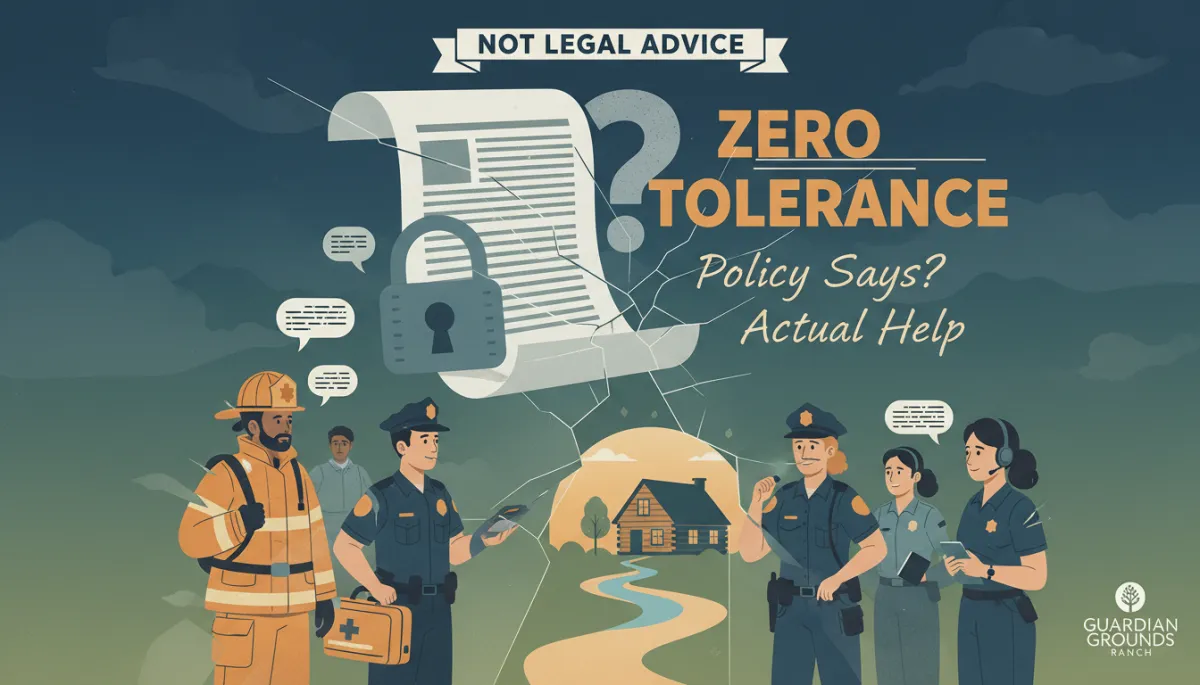
Understanding Zero Tolerance Policies for First Responders
First Responders, Drug and Alcohol Policies, Zero Tolerance
"Zero Tolerance" — What Your Agency Told You, and What the Policy Actually Says
A guide for firefighters, medics, law enforcement, dispatchers, and other public employees navigating drug and alcohol policies when they need help most.
⚠️ Important Disclaimer: This article is for general education only. It is not legal advice, and Guardian Grounds Ranch is not a law firm. Talk with a licensed employment attorney about your specific situation before making decisions.
The Story You’ve Been Told: “If You Get Caught, You’re Done”
You’ve probably heard some version of it in a briefing, academy classroom, or locker room: “We have a zero tolerance policy. If you pop positive, you’re done. No second chances.” Maybe it came from a chief, a union rep, or the salty senior medic everyone listens to. The message lands the same way: Don’t get caught. Don’t talk about it. Handle it on your own.
Picture this: a firefighter with 12 years on, solid reputation, respected on scene. The drinking started as “shift decompression,” then crept into days off, then into “just one” before bed on work nights. Sleep got worse, calls got heavier, and the bottle became the only off switch. He knows he’s not okay. He also remembers the captain standing in front of the crew saying, “If you come up hot on a test, I can’t help you. You’re gone. We’re zero tolerance here.”
So he keeps quiet. He hides the empty bottles. He tells himself he’ll cut back after this next run of shifts, after this next ugly call. He doesn’t ask his doctor about treatment. He definitely doesn’t ask HR what the policy actually says. He waits until the day he comes in smelling like last night’s whiskey and someone finally speaks up. Now there’s a reasonable-suspicion write-up, a test, and a whole chain of events he can’t control anymore.
This is how “zero tolerance” talk keeps people silent. Not because they don’t care about safety or the job, but because they’re terrified that asking for help will be treated the same as getting caught impaired on duty. The result? People wait until the crisis hits. They wait until there’s a crash, a complaint, or a positive test... when their options are the worst they’ll ever be.
Quick Reminder About What This Is — and What It Isn’t
Before we go any further, one more time in plain language: this article is not legal advice. Laws change, policies vary, and your facts matter. Guardian Grounds Ranch is a 501(c)(3) nonprofit, not a law firm. We’re talking about patterns, not telling you what will happen in your specific case. If you’re on the line right now, you need to talk with a licensed employment attorney in your state before you make big moves.
“Zero Tolerance” in the Briefing vs. “Drug‑Free Workplace” on Paper
Here’s the gap that matters: what you’re told in meetings and what’s actually written in the policy are often two very different things. On the floor, “zero tolerance” usually sounds like, “Any violation, you’re fired. Period.” On paper, the same agency might have a policy called “Drug‑Free Workplace” or “Alcohol‑Free Workplace” that uses very different language once you read it closely.
What the Written Policy Often Actually Says
Self‑referral or voluntary disclosure. Some policies have a section that says something like, “Employees are encouraged to seek assistance for substance-related problems before they result in disciplinary action” or “Self‑referral to treatment resources may be considered in lieu of discipline for a first occurrence.” That’s not zero tolerance. That’s a door (narrow, but real) if you step through before an incident. Sometimes this language may exist even when employers state differently. What is in your policy matters more than what is said, read it and know it.
Employee Assistance Program (EAP) language. Policies often mention an EAP and describe it as “voluntary,” “confidential,” or “available to employees and their families for substance use and mental health concerns.” That’s the agency admitting they know this is a real issue and that help exists. It may not protect you from every consequence, but it’s not the same as, “We don’t care; you’re gone.” Having this assistance offers real options. Consider using it, but protect your confidentiality.
Discipline “up to and including termination.” This phrase shows up a lot. It sounds scary, but it also matters legally. “Up to and including termination” means there’s a range of possible outcomes, not an automatic one. Written that way, the agency is reserving discretion to decide between counseling, last‑chance agreements, suspension, or termination depending on the situation.
Supervisor discretion and “totality of circumstances.” Some policies spell this out; others imply it. Language like “the department will consider the totality of circumstances” or “discipline will be determined on a case‑by‑case basis” is the opposite of true zero tolerance. It means your history, your honesty, and your actions before and after the issue can matter.
📌 Key Takeaway: A true zero‑tolerance rule would say something like, “Any violation of this policy will result in termination, with no exceptions.” Most public‑sector policies don’t actually say that once you read the fine print.
Why the Difference Between Talk and Text Matters
When leadership or HR leans on “zero tolerance” language in a meeting, it’s often about sending a deterrent message: we take safety seriously; we don’t want impaired people on duty. That part makes sense. The problem is when that message hides the other half of the truth: that the written policy leaves room for early self‑referral, treatment, and discretion—especially before there’s a crash or citizen complaint on your record.
If all you ever hear is “you’re done,” you’re more likely to stay silent until the worst possible moment. If you actually read the policy, you may find language that gives you leverage now—leverage you will not have after a positive test or a sustained complaint. The story you’ve been told can cost you your career if you never compare it to the text on paper.

Reading the actual policy often reveals options that locker-room talk never mentions.
The Legal Landscape You May Not Know About
Again, this is not legal advice. But there are some big‑picture federal rules that shape how public employers handle substance use. Knowing they exist can help you ask better questions and know when it’s time to bring in an attorney who understands public‑sector work.
Alcoholism and the Americans with Disabilities Act (ADA)
Under the ADA—a federal civil rights law—alcoholism can qualify as a disability. In plain language, that means if you have a diagnosed alcohol use disorder, your employer may have a legal duty to consider “reasonable accommodations.” One common example of an accommodation is time off or schedule changes to attend treatment or counseling. Legal resources note that employees in recovery, or in supervised treatment and not currently using illegally, are often protected under this law, even while employers still enforce performance and safety rules (legalclarity.org).
Here’s the key tension: the ADA does not require an employer to allow you to be impaired on duty, show up drunk, or bring alcohol to work. They can still enforce fitness‑for‑duty standards, drug and alcohol testing, and discipline for on‑duty impairment. But if you raise your hand and say, “I have a problem and I need treatment,” before there’s a big incident, the ADA may come into play in terms of how they handle your request for help and leave.
Substance‑Use Treatment and the Family and Medical Leave Act (FMLA)
The FMLA is another federal law that gives eligible employees up to 12 weeks of job‑protected, unpaid leave for certain serious health conditions. Substance‑use treatment—when it’s provided by a healthcare provider or in a licensed program—can qualify as one of those conditions. Legal summaries emphasize that FMLA leave can cover the time you’re actually in treatment, not the days you show up impaired (legalclarity.org).
That means, if you qualify for FMLA and you act before there’s a major incident, you may have a legal right to step away for rehab or intensive outpatient treatment with your job protected—within the limits of the law and your agency’s staffing realities. Again, this is where a good employment attorney earns their money: helping you time and structure that request in a way that protects you as much as possible.
The Federal Drug‑Free Workplace Act and Public Agencies
Many public employers—cities, counties, state agencies—receive federal funds or grants. When they do, they usually have to comply with the Federal Drug‑Free Workplace Act. That law requires them to publish a policy prohibiting illegal drugs at work, run a drug‑free awareness program, and require reporting of certain drug convictions. Interestingly, it does not actually require drug testing; that’s something employers layer on top to show they’re serious (legalclarity.org).
Many agencies interpret “drug‑free workplace” as including some kind of path to treatment—EAP referrals, education, and sometimes last‑chance agreements. That doesn’t mean they’ll ignore violations, especially in safety‑sensitive roles. But it does mean there’s usually more going on behind the scenes than “use once and you’re fired, no questions asked.”
⚠️ One More Time: These are general federal frameworks. How they apply to you depends on your state, your union contract, your agency’s policies, and your specific facts. A licensed employment attorney who understands public safety work is the right person to connect these dots in your case.
The Critical Window: Before vs. After
Here’s the hard truth, from watching a lot of careers play out: your options are dramatically better before something is written down. “Something” can be a positive test, a crash report, a citizen complaint, a body‑cam review, or a reasonable‑suspicion write‑up. Once that’s in the system, everything gets tighter: policies, politics, and public optics all close in.
Before: When You Still Have Room to Move
You can explore self‑referral language in the policy and decide how to use it.
You can quietly talk to an EAP counselor, a therapist, or a place like Guardian Grounds Ranch to get your head straight about options.
You can consult a private employment attorney before you say anything formal to the agency, so your first move is intentional, not panicked.
You can plan for FMLA or other leave options in a way that doesn’t blindside your chain of command or leave your crew in a bind.
In that “before” window, your honesty, your work history, and your willingness to get help can all be weighed as part of the “totality of circumstances.” Supervisors and chiefs—many of whom have seen this up close in their own lives—often have more room to work with you than they admit in staff meetings. But they rarely say that out loud.
After: When the Paperwork Leads the Way
A positive test, crash, or complaint triggers formal processes—internal affairs, risk management, city attorneys, maybe even the media.
Decision‑makers feel pressure to “send a message” to the public and the rest of the agency, especially in safety‑sensitive roles.
The same policy language that used to be flexible suddenly gets read in the harshest possible way, because everyone is now protecting the organization, not just you.
None of this is to scare you. It’s to underline one thing: if you already know you’re in trouble with alcohol or substances, the best time to act was yesterday; the second‑best time is right now, before the incident. That’s the window where you still have some control over how the story gets told and who tells it first.
Where Guardian Grounds Ranch Fits In
Guardian Grounds Ranch exists outside your chain of command. We’re a 501(c)(3) nonprofit built specifically for veterans and first responders. We are not HR. We are not your chief. We are not your IA investigator. We’re a confidential, culturally competent resource where you can say the quiet parts out loud without it going into your personnel file. We help you sort through what you’re facing, what your options might be, and how to move toward real help without blowing up your life if you can avoid it.
What to Do If You’re Struggling and Afraid to Speak Up
1. Do not wait for a critical incident to force the issue. If you’re already worried about how much you’re drinking, using pills, or relying on anything to get through shifts or days off, that’s your warning light. You don’t need a crash, a DUI, or a positive test to “prove” you have a problem. Waiting almost always makes the fallout worse—for you, for your family, and for the people you serve.
2. Ask to see the written policy and handbook. Don’t rely on what you heard in orientation or in a heated staff meeting. Request a copy of your drug and alcohol policy, your general conduct policy, and your union contract if you have one. You’re allowed to read the rules that govern your career. Look for words like “self‑referral,” “voluntary disclosure,” “EAP,” “up to and including termination,” and “totality of circumstances.”
3. Use confidential resources outside the department. Talk with people who aren’t in your chain of command: a trusted therapist, a peer support person who understands confidentiality, or organizations like Guardian Grounds Ranch. We operate outside your agency and outside your personnel system. You can process your fear, your options, and your next steps without it automatically triggering HR or IA.
4. Consult a private employment attorney before formal disclosures. Especially if you’re considering telling your employer about a substance‑use issue, asking for leave, or entering treatment, a short consult with an attorney who knows public‑sector and union environments can be a game‑changer. They can help you understand how ADA, FMLA, your contract, and your policy all fit together in your situation, and how to time your disclosures to protect yourself as much as possible.
5. Document conversations that don’t match the written policy. If HR or a supervisor tells you, “We don’t have any options; it’s pure zero tolerance,” but the policy mentions EAP, self‑referral, or “up to and including termination,” write down the date, time, and what was said. Save emails. This isn’t about being sneaky; it’s about having a clear record if you and your attorney later need to show that what you were told didn’t line up with the rules on paper.
6. Start building your support team now. Recovery is hard enough without trying to do it solo. Let at least one trusted person in your life know what’s going on—a partner, a close friend, a fellow responder who “gets it” and can keep confidence. Consider reaching out to a clinician who understands first responder culture, or to Guardian Grounds Ranch, where we combine nature, relationship, and peer understanding as part of the healing process.
7. Remember that asking for help is not the same as admitting guilt for misconduct. There’s a big difference between saying, “I showed up impaired on duty last week” and saying, “I have a drinking problem and I need treatment.” The law and your policy may treat those two situations very differently. This is another reason to get legal advice before you start sharing detailed timelines with your employer.
A Culture That Says “Be Tough” — and the Truth About Being Human
If you’ve spent any time in fire, EMS, law enforcement, dispatch, or corrections, you’ve been marinated in the same message: be tough, don’t show weakness, handle your own stuff. You learn early not to be “that guy” or “that girl” who can’t hack it. You joke about the calls that should probably break you. You go home and try to turn it all off however you can—booze, pills, weed, energy drinks, sleepless nights, whatever it takes to get through the next shift.
Here’s the part the culture doesn’t say out loud: needing help with alcohol or substances is a human problem, not a moral failure. It’s a predictable response to chronic trauma, disrupted sleep, hyper‑vigilance, and the kind of scenes most people only see in movies. You didn’t create this system. You’re working inside it, doing the best you can with the tools you were given. Sometimes those tools stop working. That doesn’t make you broken. It makes you human.
How Guardian Grounds Ranch Can Walk With You
Guardian Grounds Ranch was built for people exactly like you—veterans and first responders who have carried more than their share and are tired of pretending they’re fine. We’re a 501(c)(3) nonprofit that uses nature, community, and honest conversation to help people heal. We operate completely outside your chain of command. Your chief doesn’t get a report. Your HR department doesn’t get a memo. You get space to breathe, tell the truth, and figure out your next right step with people who understand the culture you come from.
If you’re reading this and feeling that mix of fear and relief—“This is me, but I don’t know what to do”—you don’t have to figure it out alone. Reach out. Ask questions. Let someone sit with you in the mess without judgment. Whether you end up using an EAP, going to treatment, using FMLA, or taking another path, you deserve support that doesn’t treat you like a disposable problem to be managed.
Final Disclaimer: This article is general information, not legal advice; talk with a licensed employment attorney about your specific situation.

Sign Up For Our Newsletter to Get the Details Early!
Copyright 2024 . All rights reserved


